Buying a home in Washington, D.C. is as exciting as it is complex — especially when it comes to financing. Between the city’s high property values, generous assistance programs, and unique tax structure, there’s a lot to unpack.
Whether you’re a first-time buyer or a seasoned homeowner looking to upgrade, understanding the ins and outs of the Washington DC mortgage ecosystem will help you make smarter, more confident decisions.
Let’s break it down.
Navigating D.C.’s High Loan Limits

Understanding Conforming Loan Limits
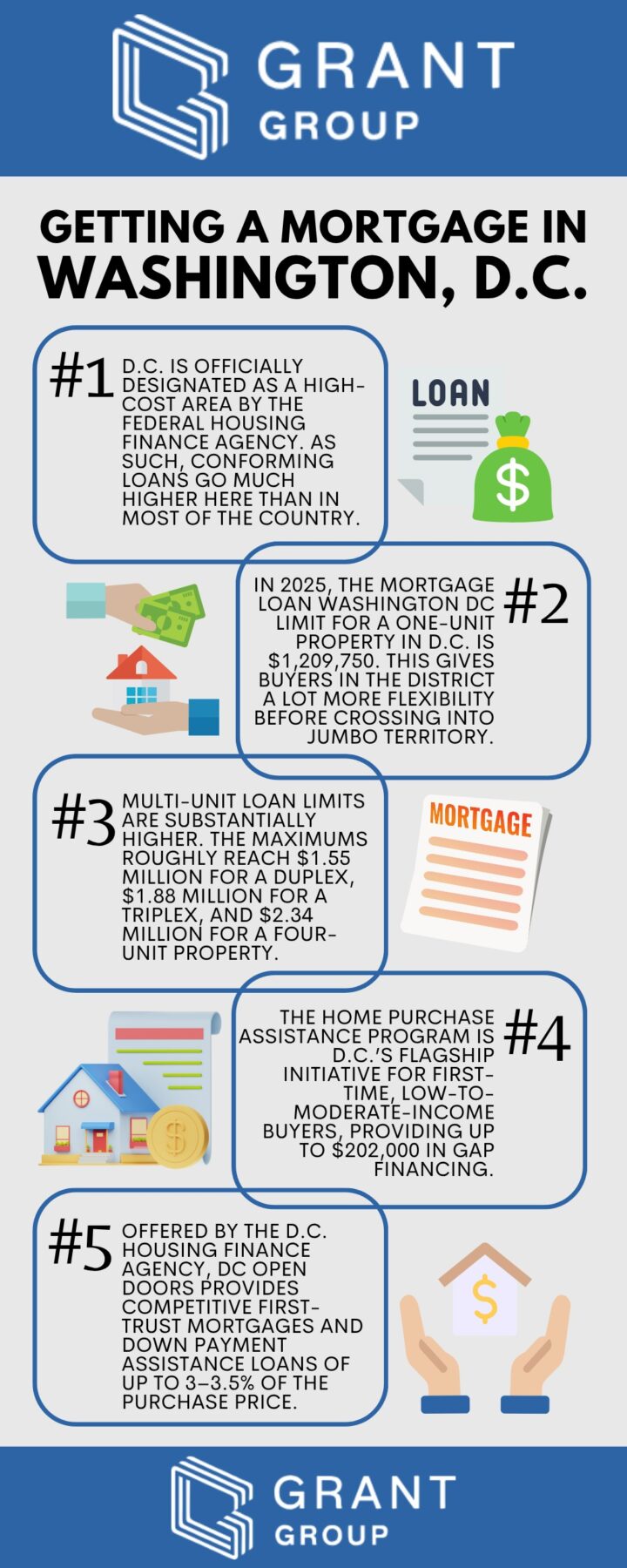
D.C. is officially designated as a high-cost area by the Federal Housing Finance Agency (FHFA). That means conforming loans — the ones backed by Fannie Mae and Freddie Mac — go much higher here than in most of the country.
In 2025, the mortgage loan Washington DC limit for a one-unit property in D.C. is $1,209,750. This gives buyers in the District a lot more flexibility before crossing into jumbo territory.
FHA Loan Limits
The Federal Housing Administration (FHA) also adjusts its limits for high-cost markets like D.C. For 2025, the FHA loan ceiling matches the high-cost conforming limit of $1,209,750 for a one-unit home.
FHA loans remain a popular choice for first-time buyers thanks to their 3.5% minimum down payment and lenient credit requirements.
Jumbo Loans
Once your loan amount exceeds that $1.2 million mark, you’re entering jumbo loan territory.
Jumbo mortgages aren’t backed by Fannie Mae or Freddie Mac, so they come with stricter requirements — think higher credit scores (typically 720+), larger down payments (10–20%), and more cash reserves.
The upside? They’re a great tool for financing D.C.’s luxury condos, historic rowhomes, and new builds in high-demand neighborhoods.
Multi-Unit Limits
Here’s a hidden gem for buyers thinking strategically: D.C.’s multi-unit loan limits are substantially higher.
In 2025, the maximums roughly reach $1.55 million for a duplex, $1.88 million for a triplex, and $2.34 million for a four-unit property. That’s especially appealing for house hackers — buyers who live in one unit and rent out the others to offset their mortgage.

D.C.-Specific Homebuyer Assistance Programs
Washington, D.C. is one of the most supportive cities in the nation for homebuyers. The District offers several programs that can dramatically reduce upfront costs and improve long-term affordability.
Home Purchase Assistance Program (HPAP)
The Home Purchase Assistance Program (HPAP) is D.C.’s flagship initiative for first-time, low-to-moderate-income buyers.
It provides up to $202,000 in gap financing (a second, deferred payment loan that bridges the affordability gap) and up to $4,000 in closing cost assistance.
The loan is interest-free and deferred — repayment doesn’t begin until you sell, refinance, or move out of the property. The exact amount you qualify for depends on your income, household size, and debt load.
DC Open Doors
Offered by the D.C. Housing Finance Agency (DCHFA), DC Open Doors provides competitive first-trust mortgages along with down payment assistance loans (DPAL) of up to 3–3.5% of the purchase price.
The DPAL is deferred and non-amortizing, meaning no monthly payments — it’s repaid only when you sell or refinance. Best of all, this program is open to both first-time and repeat buyers (as long as you meet the income limits and credit requirements).
DC4ME
DC4ME caters to D.C. government employees — including teachers, first responders, and city agency staff.
It offers below-market Washington DC mortgage rates and optional down payment assistance of up to 3%. It’s a fantastic way for local employees to live where they serve.
Mortgage Credit Certificates (MCC)
While D.C.’s Mortgage Credit Certificate (MCC) program isn’t always active, it’s worth checking with a DCHFA-approved lender to see if it’s available.
MCCs allow qualifying homeowners to claim a federal tax credit for a portion of annual mortgage interest, which effectively increases take-home income and boosts affordability.

Standard Mortgage Products in the District
Even with assistance programs, most D.C. homebuyers will choose from a handful of well-known loan types.
Conventional Loans
Down payments can be as low as 3% for qualified buyers, though putting down at least 20% helps you avoid Private Mortgage Insurance (PMI).
FHA Loans
Require just 3.5% down with a minimum credit score of 580, but you’ll pay a Mortgage Insurance Premium (MIP) upfront and monthly.
VA Loans
Available to veterans, service members, and eligible spouses, VA loans offer zero down payment and no mortgage insurance — a huge benefit in a high-cost market like D.C.
Credit and DTI
Most lenders in the District look for minimum credit scores of 640–660 and Debt-to-Income (DTI) ratios below 45–50%. Jumbo and specialized programs may have stricter standards.

Understanding D.C.’s Unique Closing Costs and Taxes
Average Closing Costs
D.C. consistently ranks among the top U.S. markets for high closing costs. Buyers should expect to spend roughly 2% to 5% of the purchase price on closing expenses, including lender fees, title charges, and prepaids.
Transfer and Recordation Taxes
One big factor? D.C.’s transfer and recordation taxes, which are each 1.1% for homes under $400,000 and 1.45% for homes priced at $400,000 or more. Together, they can add nearly 3% to your transaction costs — so budgeting for them is crucial.
Tax Abatement for First-Time Buyers
Here’s a potential money-saver: qualified first-time D.C. buyers may be eligible for the First-Time Homebuyer Tax Abatement, which can eliminate transfer and recordation taxes entirely and reduce your property tax rate for the first five years.
Customary Cost Splits
In D.C., it’s customary for the buyer to pay lender fees, appraisal, and recordation tax, while the seller typically covers the owner’s title insurance policy and transfer tax. A knowledgeable agent and title company can help you structure a fair deal.
The D.C. Mortgage Application Pipeline: From Pre-Approval to Close
The Pre-Approval Process
Pre-approval is your first major step — and in D.C., it’s especially important to work with a DCHFA-approved lender if you plan to use programs like HPAP or DC Open Doors. A strong pre-approval also strengthens your offer in the city’s competitive housing market.
Working with Local Professionals
D.C. real estate contracts include local riders and disclosures that differ from those in Maryland and Virginia. Partnering with an experienced D.C. agent and title company ensures you navigate local requirements confidently.
Homebuyer Education Requirement
Most local assistance programs, including HPAP and DC Open Doors, require completion of a homebuyer education course. These classes can usually be taken online and must be completed before settlement.
Closing Day
On closing day, you’ll sign your final documents, wire funds, and record the deed with the D.C. Recorder of Deeds. Once recorded, the property is officially yours — congratulations!
Conclusion
Buying in Washington, D.C. comes with unique opportunities and responsibilities. From generous loan limits and city-backed assistance to competitive mortgage products and nuanced tax rules, understanding the full picture helps you make better financial moves.
With the right lender, agent, and preparation, your path to D.C. homeownership can be both smooth and rewarding.
Have any questions? Feel free to give me a call today at 202-577-8428 or send me an email at James@theGrantGroup.com to schedule an appointment.
Frequently Asked Questions
Limits vary by household size and are updated annually. In 2025, they range roughly from $100,000 to $190,000, depending on your family size. Always check the current HPAP table before applying.
No. DC Open Doors is available to both first-time and repeat buyers, as long as you meet the income and credit criteria.
D.C.’s combined rate (up to 2.9%) is generally higher than Maryland’s or Virginia’s, where total transfer taxes often fall between 1% and 1.5%.
Yes, most programs require you to either live or work in D.C. and intend to occupy the property as your primary residence.
The HPAP purchase price cap adjusts annually; for 2025, it’s around $725,000 for eligible buyers.
Yes — HPAP can be paired with FHA, VA, or conventional first-trust loans from approved lenders.
Visit the DCHFA website or ask your realtor for a list of approved HPAP or DC Open Doors lenders.
Absolutely. Condos and co-ops qualify as long as they meet the program’s eligibility requirements and you occupy the property as your primary home.