Rising interest rates have become the headline everyone loves to hate. But in the Washington, DC luxury condo market, the story is far more nuanced than the national soundbites suggest.
While higher borrowing costs have undeniably slowed parts of the market, they’ve also reshaped buyer behavior, shifted negotiating power, and revealed which segments of DC high-end real estate are truly resilient.
If you’re watching the luxury condo scene from Georgetown to The Wharf, here’s what’s really happening on the ground in 2026—and what it means for buyers and sellers navigating Washington DC luxury real estate right now.

The 2026 DC Luxury Condo Market Landscape
Market Cooling vs. Resilience
There’s no question that transaction volume in the luxury condo segment has cooled compared to the post-pandemic peak. However, the slowdown has been more measured than what we’ve seen in the single-family home sector.
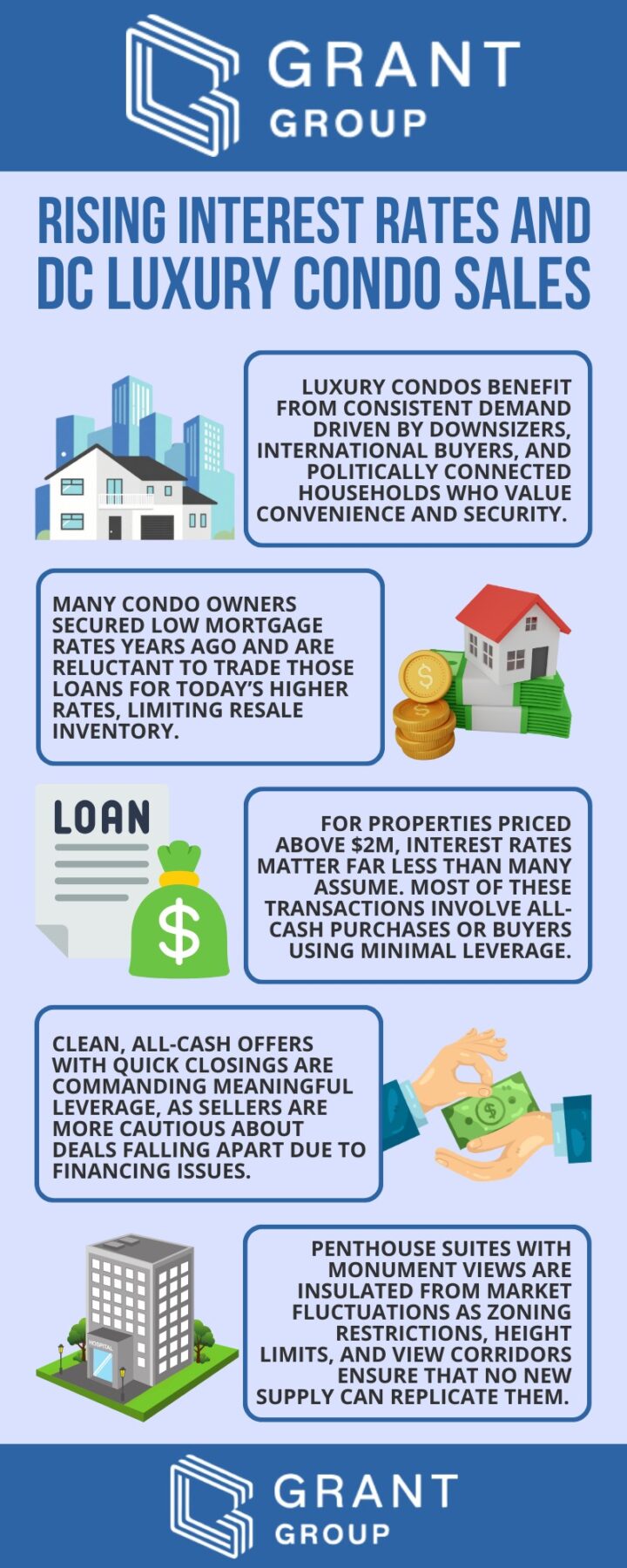
Luxury condos—particularly in prime, walkable neighborhoods—have benefited from consistent demand driven by downsizers, international buyers, and politically connected households who value convenience and security.
Instead of dramatic price drops, the market has shifted toward normalization: fewer bidding wars, longer listing timelines, and more thoughtful decision-making.
For buyers, this has translated into a more balanced environment. Due diligence periods are no longer rushed, inspections are back on the table, and negotiations feel collaborative rather than competitive.
The “Lock-In” Effect
One of the quiet forces shaping inventory levels is the lock-in effect. Many current condo owners secured historically low mortgage rates years ago and are reluctant to trade those loans for today’s higher rates.
In DC’s high-end real estate market, this hesitation has limited resale inventory, particularly in well-managed boutique buildings. While demand hasn’t disappeared, the supply side remains constrained—especially for premium units with strong views, layouts, or locations.
Cash Is King in the Capital
Insulation from Rates
At the ultra-luxury level—generally properties priced above $2 million—interest rates matter far less than many assume. A significant portion of these transactions involves all-cash purchases or buyers using minimal leverage.
This reality has insulated the top tier of the Washington, DC luxury condo market from the worst effects of rising rates. For these buyers, lifestyle, location, and long-term asset preservation outweigh short-term financing considerations.
Leverage for Cash Buyers
Cash buyers, however, aren’t just insulated—they’re empowered. In a higher-rate environment, sellers are more cautious about deals falling apart due to financing issues. As a result, clean, all-cash offers with quick closings are commanding meaningful leverage.
We’re seeing cash buyers negotiate price reductions, favorable contingencies, and closing cost credits—especially when sellers are motivated or facing timelines tied to relocation or estate planning.

Georgetown vs. The Wharf Condos Performance
Historic Stability
Established neighborhoods like Georgetown continue to demonstrate remarkable stability. Strict zoning regulations, historic preservation rules, and limited development opportunities mean supply remains perpetually tight.
Luxury condos in Georgetown appeal to buyers focused on long-term value retention rather than short-term appreciation. These properties often behave more like legacy assets, making them attractive to wealth preservation-minded buyers during periods of economic uncertainty.
New Development Volatility
By contrast, newer areas such as The Wharf have experienced more volatility. With multiple phases of development and remaining developer inventory, buyers have more options—and more negotiating power.
To counteract the impact of rising interest rates, developers may adjust pricing strategies, offer incentives, or explore financing concessions. While this creates opportunity for buyers, it also introduces short-term pricing variability that’s less common in historic neighborhoods.
The Hidden Impact of Condo Fees in DC
Total Monthly Cost
Interest rates don’t exist in a vacuum. In DC, condo fees play a significant role in the total monthly cost of ownership—and those fees can be substantial in luxury buildings.
When higher mortgage payments are combined with elevated condo fees, buyers are increasingly focused on the “total carry” rather than just the purchase price. This has become a critical factor in affordability discussions, especially for financing-dependent buyers.
Amenity ROI
As costs rise, buyers are also scrutinizing amenities more closely. Features like 24-hour concierge services, pools, and valet parking are still desirable, but buyers are asking tougher questions about value.
In some cases, lower-fee buildings with fewer amenities are becoming more competitive, particularly among buyers prioritizing flexibility and long-term holding costs over hotel-style services.
Why Penthouse Suites with Monument Views Resist Trends
Scarcity Value
Certain assets simply operate in their own micro-economy. Penthouse suites with monument views fall squarely into that category.
These properties are inherently scarce. Zoning restrictions, height limits, and view corridors ensure that no new supply can replicate them. As a result, they remain largely insulated from broader market fluctuations.
Washington, DC Luxury Appeal
Washington, DC, holds a unique position among global cities. It attracts diplomats, executives, political leaders, and international buyers who value privacy, prestige, and proximity to power.
For these buyers, trophy properties serve as both residences and statements. Demand for such homes tends to persist regardless of interest rate cycles, reinforcing their long-term value within the Washington DC luxury market.
Frequently Asked Questions
Days on market have generally increased, reflecting a shift toward more deliberate buying rather than distress or oversupply.
Yes, many ask is Washington, DC expensive to live in—and while pricing can rival other East Coast cities, DC often offers better value per square foot in the luxury condo segment.
Historically, well-located luxury condos in DC have demonstrated resilience, particularly those in supply-constrained neighborhoods.
Fees vary widely depending on amenities, staffing, and building age, but luxury buildings generally command higher per-square-foot fees.
Some developers are exploring financing incentives or pricing adjustments to remain competitive in a high-rate environment.
That depends on priorities. Georgetown favors stability and scarcity, while newer areas may offer pricing flexibility and incentives.
Jumbo loans remain available, though underwriting standards are more conservative and rates remain higher than in prior years.
Key Takeaway
While rising interest rates have cooled the broader housing market, the Washington DC luxury condo market remains layered and opportunity-rich.
Cash buyers and those targeting scarce assets—such as penthouse suites with panoramic views—are finding strategic entry points. Financing-dependent buyers, meanwhile, must be diligent in calculating total ownership costs, factoring in both mortgage interest and condo fees in DC.
Understanding these dynamics is essential for making confident, well-timed decisions in today’s evolving landscape of DC high-end real estate trends.
If you’re considering a move within the Washington DC luxury condo market—or simply want a clear-eyed perspective on how rising interest rates affect your buying or selling strategy—it helps to talk with someone who understands the nuances behind the numbers.
Whether you’re weighing a penthouse with monument views, comparing historic Georgetown to newer waterfront developments, or calculating the true monthly carry of a luxury condo, thoughtful guidance can make all the difference.
You can reach me at 202-577-8428 or via email at James@theGrantGroup.com to start a straightforward, no-pressure conversation about your next move in Washington, DC luxury real estate.